
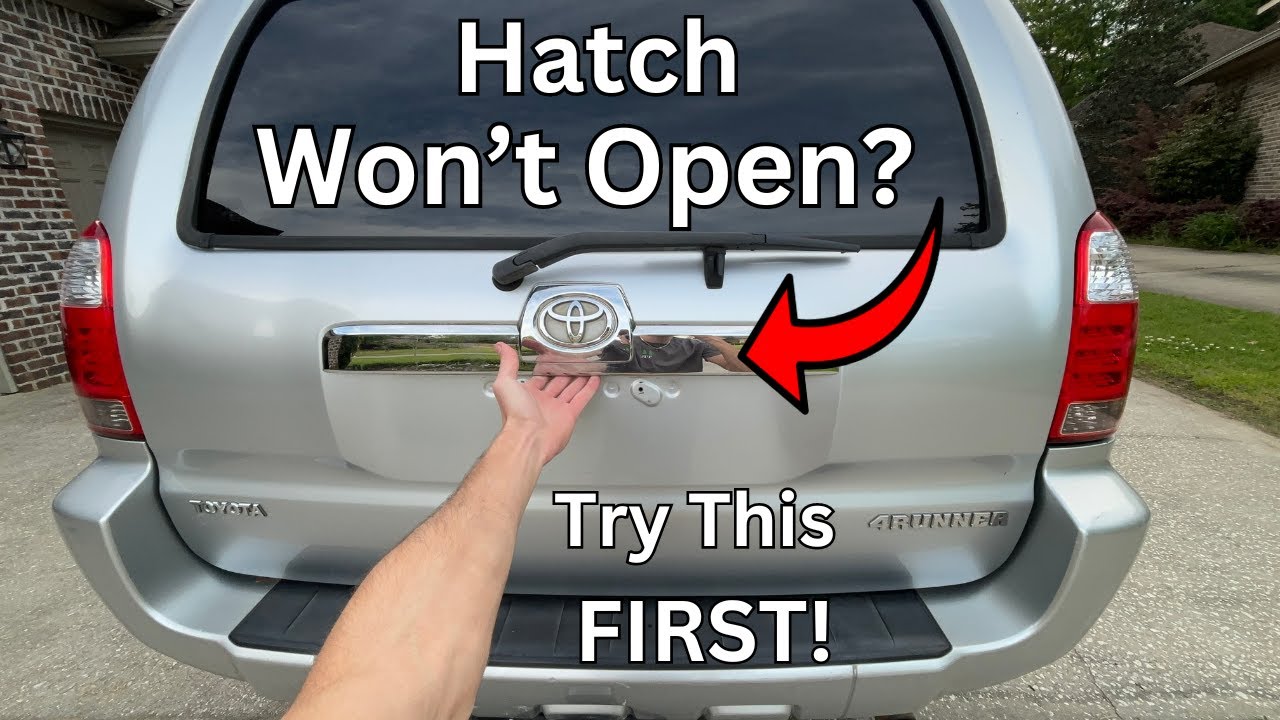
To reset a Toyota 4Runner rear hatch, press and hold the rear hatch close button on the liftgate for approximately 10 seconds until you hear a beep, then manually close the hatch fully and reopen it using the key fob or dashboard button. This recalibrates the power liftgate motor and restores normal operation.
If your 4Runner’s rear hatch is acting up—stopping halfway, refusing to latch, or not responding to the fob at all—you are not alone. This is one of the most complained-about electrical quirks on 5th-generation models, and dealerships love to charge $200 to $400 for something you can fix in your driveway in under five minutes.
I have walked dozens of owners through this exact reset, and in most cases, no parts are needed. Below is everything you need to know to get your rear hatch working again.
How Do I Reset the Toyota 4Runner Power Liftgate?
The fastest method is to press and hold the close button on the underside of the liftgate for 10 seconds until you hear an audible beep. After the beep, manually push the hatch all the way down until it latches. Then press the open button on your key fob or the dashboard to verify the hatch opens and closes to its full programmed height.
Step-by-Step Reset Procedure for 5th Gen (2010–2024)
- Make sure the vehicle is in Park and the engine is running or the ignition is in the ON position.
- Open the rear hatch using the interior button or key fob and let it travel to its fully open position.
- Locate the close button on the underside of the liftgate panel—the small rubber-covered switch near the handle.
- Press and hold that close button for a full 10 to 15 seconds. You should hear one or two beeps indicating the system has entered reset mode.
- Manually push the hatch down by hand until it fully latches. Do not slam it—guide it smoothly.
- Wait three seconds, then press the open button on your key fob or the dash-mounted liftgate button.
- The hatch should now travel to its correct fully open height. If it does, the reset is complete.
Alternative Battery Disconnect Reset
If the button-hold method does not work, disconnect the negative battery terminal for 10 to 15 minutes. This forces a full hard reset of the body control module. After reconnecting the terminal, start the vehicle and cycle the hatch open and closed three times to re-teach the system its limits.
4th Gen (2003–2009) Manual Hatch Considerations
The 4th-gen 4Runner does not have a power liftgate, so there is no electronic reset procedure. If your 4th-gen hatch feels stuck or will not stay open, the issue is almost always the gas struts, which are covered below in detail.
Why Does My 4Runner Rear Hatch Stop Midway When Opening?
A hatch that stops halfway usually has an obstruction detection trigger, a weak motor, or a calibration issue. The system uses a pinch sensor and motor resistance to detect objects, and if it senses abnormal resistance, it will stop and reverse as a safety feature.
Cause 1: Obstruction Sensor Trip
Dirt, ice, or a misaligned weatherstrip can trick the sensor into thinking something is blocking the path. Clean the entire hatch channel and weatherstrip with a mild soap solution. Pay close attention to the rubber seals along the roof rail where the hatch tucks in—debris here is the number one false trigger.
Cause 2: Weak or Failing Liftgate Struts
The gas struts that assist the power motor lose pressure over time, especially after three to five years or in extreme heat. When they weaken, the motor has to work harder and may interpret the added resistance as an obstruction. Replace both struts as a pair—they cost around $25 to $40 each for aftermarket units and take about 10 minutes with a flathead screwdriver.
Cause 3: Liftgate Motor Calibration Drift
Over time and many cycles, the motor’s encoder can lose its reference points. This is the most common reason owners need to perform the reset procedure described above. A recalibration after strut replacement is especially important since the motor needs to learn the new resistance profile.
What Causes the Toyota 4Runner Rear Hatch to Not Open at All?
When the hatch will not respond to any input, the issue is usually a blown fuse, a failed latch actuator, or a faulty key fob signal. Start with the simplest possibilities before assuming the worst.
Check the Liftgate Fuse First
Open the interior fuse box located under the dashboard on the driver’s side. The power liftgate fuse is typically a 20-amp fuse labeled P/W or BACK DOOR.
Pull it, inspect the filament for a break, and replace if necessary. This fixes the problem more often than you would think.
Test the Key Fob Signal
Hold the key fob directly against the rear hatch button and press it. If the hatch opens at close range but not from a distance, your fob battery is weak.
Replace the CR2016 or CR2032 battery depending on your fob model. Also, test the interior dash-mounted liftgate button to rule out a fob-only issue.
Latch Actuator Failure
If you hear the motor trying to work but the latch will not release, the actuator mechanism inside the hatch is likely seized or broken. This part runs about $80 to $150 and requires removing the interior hatch panel. Apply penetrating lubricant to the latch mechanism first—sometimes corrosion is the only problem.
How Much Does a Dealership Charge to Fix the Rear Hatch?
A dealership will typically charge between $150 and $500 depending on the diagnosis. Most will start with a $120 to $150 diagnostic fee, then quote parts and labor on top. For a simple reset or strut replacement, independent shops charge roughly $80 to $200 total, while a full latch actuator replacement may run $250 to $400 at an independent shop.
| Repair Type | Dealership Cost | Independent Shop Cost | DIY Cost |
|---|---|---|---|
| Liftgate Reset | $120–$150 (diagnostic) | $50–$80 | $0 |
| Gas Strut Replacement (pair) | $150–$250 | $100–$180 | $50–$80 |
| Latch Actuator Replacement | $300–$500 | $200–$350 | $80–$150 |
| Fuse Replacement | $80–$120 | $40–$60 | $2–$5 |
| Liftgate Motor Replacement | $400–$700 | $300–$500 | $150–$300 |
How to Program the 4Runner Rear Hatch Opening Height
If the hatch opens too high for your garage or too low for convenient loading, you can set a custom height. Open the hatch to the desired position, then press and hold the close button until you hear two beeps. The hatch will now remember that height as its default fully open position.
Reverting to Full Height
To restore full opening height, open the hatch to the maximum position manually, then press and hold the close button until you hear two beeps again. The system overwrites the previous setting with the new maximum.
When Programming Will Not Save
If the hatch ignores your height setting, the control module may need a hard reset via battery disconnect. Some owners have also found that performing the reset with the engine running rather than just in accessory mode makes the programming stick more reliably.
Frequently Asked Questions
Can I drive with a rear hatch that will not close?
Driving with an unlatched hatch is dangerous and may trigger dashboard warnings or cause the hatch to open unexpectedly. If the latch will not engage, use a bungee cord or ratchet strap as a temporary measure, but get it repaired as soon as possible.
Does the 4Runner rear hatch have a manual override?
Yes. On 5th-gen models, there is a small access panel on the inside of the hatch near the latch. Remove the panel and you will find a manual release lever that allows you to open the hatch from inside the cargo area if the electronic system fails completely.
Why does my rear hatch beep but not move?
A beep with no movement usually indicates the motor is receiving the command but cannot overcome resistance. This is most commonly caused by frozen gas struts in cold weather or severely worn struts that no longer provide assist. Replace the struts and try the reset again.
Is the rear hatch issue covered under Toyota warranty?
Power liftgate components are covered under the 3-year/36,000-mile basic warranty and the 5-year/60,000-mile powertrain warranty may apply to the motor itself. If you have an extended Toyota Extra Care plan, check your contract—many plans cover body electronics beyond the standard warranty period.
Will an aftermarket liftgate strut cause problems?
Quality aftermarket struts from brands like StrongArm or Sachs work fine and are functionally identical to OEM. Avoid no-name struts from discount sites—incorrect pressure ratings can cause the hatch to slam shut or refuse to close fully, which forces repeated resets.
Final Thoughts: Get Your 4Runner Hatch Working Without Overpaying
The Toyota 4Runner rear hatch reset is a simple calibration procedure that the majority of owners can perform at home in under five minutes. Before you agree to any dealership diagnostic fee, try the button-hold reset, check your fuses, and inspect your struts.
These three steps resolve roughly 80 percent of all rear hatch complaints on 4Runners. If the problem persists after a reset and strut swap, then the latch actuator or liftgate motor is the likely culprit—parts you can still replace yourself with basic hand tools and an afternoon.
Leave a Reply